
Hidden Gems in Indonesia | For decades, the mention of Indonesia has almost universally conjured up images of Bali. From the emerald rice terraces of Ubud and the cliffside temples of Uluwatu to the buzzing beach clubs of Seminyak, the “Island of the Gods” has long been the crown jewel of Indonesian tourism.
However, Bali’s skyrocketing popularity has come at a cost. Overtourism, gridlocked traffic, crowded beaches, and commercialized cultural performances have left many intrepid travelers asking a crucial question: Is there an authentic, untouched paradise left in Indonesia?
The short answer is yes, absolutely.
Indonesia is the world’s largest archipelagic state, boasting over 17,000 islands spanning across three time zones. Beyond the borders of Bali lies a sprawling realm of smoking volcanoes, prehistoric lizards, pristine coral reefs that harbor the world’s highest marine biodiversity, and ancient tribes whose ways of life have remained unchanged for centuries.
If you are ready to escape the tourist traps, bypass the influencer crowds, and discover the raw, beating heart of the archipelago, here are the ultimate hidden gems in Indonesia that you need to visit.
Daftar Isi :
1. The Komodo Archipelago & Flores: Beyond the Dragons
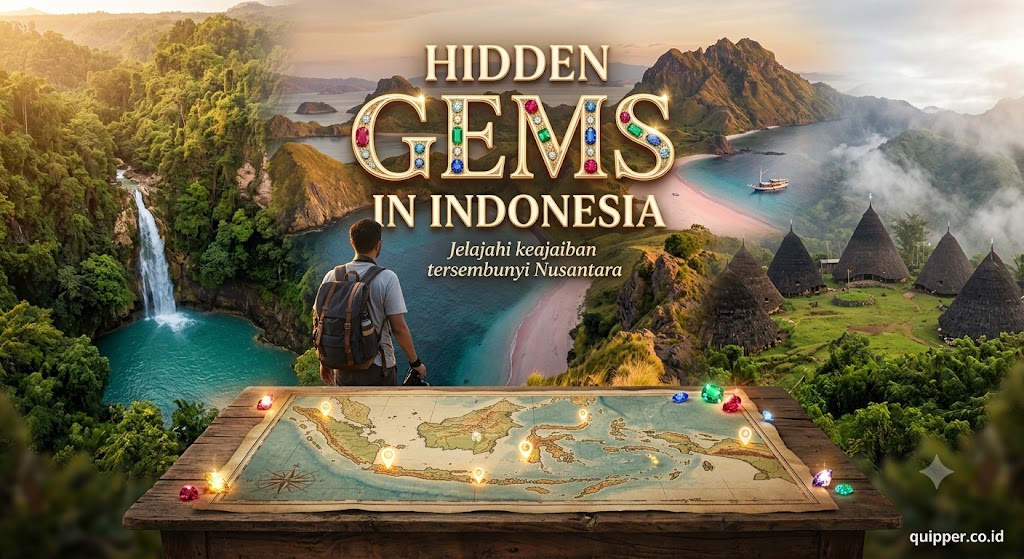
While Labuan Bajo has grown in popularity as the gateway to see the legendary Komodo Dragons, the wider region of Flores and the surrounding lesser-known islands within the Komodo National Park remain vastly untamed compared to Bali.
The Surreal Landscape of Padar and Kelimutu
Most travelers visit for the dragons, but they stay for the mind-bending landscapes. Padar Island offers a prehistoric vista of three crescent-shaped bays, each featuring a different color of sand: pearlescent white, charcoal black, and a rare, soft pink.
Further inland on the island of Flores lies Mount Kelimutu, a dormant volcano famous for its three volcanic crater lakes. What makes Kelimutu a true hidden gem is that these lakes unpredictably change colors—from turquoise and olive green to deep chocolate brown and pitch black—due to shifting chemical reactions from subterranean volcanic gases. To the local Lio tribe, these lakes are the sacred resting places of departed souls.
Pristine Marine Exploration
Unlike the crowded, heavily commercialized waters of Bali’s southern beaches, the Komodo Archipelago sits within the Coral Triangle.
- Manta Point: Drift swim alongside gentle giants with wingspans reaching up to 4 meters.
- Pink Beach: One of only a handful of genuine pink sand beaches in the world, colored by microscopic organisms called Foraminifera mixed with white sand.
2. Raja Ampat: The Last Paradise on Earth
If your definition of a hidden gem involves absolute seclusion, surreal natural architecture, and unrivaled marine life, then Raja Ampat in West Papua is your ultimate destination. Located off the northwest tip of Bird’s Head Peninsula, Raja Ampat (meaning “Four Kings”) is an archipelago comprising over 1,500 small islands, cays, and shoals surrounding the four main islands of Misool, Salawati, Batanta, and Waigeo.
The Epicenter of Marine Biodiversity
Marine biologists widely consider Raja Ampat to have the richest coral reef ecosystems on the planet. According to Conservation International, over 75% of the world’s coral species and more than 1,400 species of fish can be found in these waters.
Raja Ampat Biodiversity Breakdown:
┌───────────────────────────┐
│ 75% of World's Corals     │ ──► Over 500 hard coral species
├───────────────────────────┤
│ 1,400+ Fish Species       │ ──► Pygmy seahorses to Wobbegong sharks
├───────────────────────────┤
│ Pristine Mangrove Systems │ ──► Unique marine-terrestrial ecotones
└───────────────────────────┘
The Iconic Wayag and Piaynemo Views
Images of Raja Ampat often feature steep, mushroom-shaped karst islets rising dramatically out of a translucent turquoise sea. Climbing to the wooden viewing platform atop Piaynemo or tackling the rugged limestone cliffs of Wayag offers a panoramic view that easily eclipses any viewpoint in Bali. It feels less like a tourist destination and more like the dawn of creation.
3. Derawan Islands: East Kalimantan’s Aquatic Utopia
Tucked away in the Celebes Sea off the coast of East Kalimantan (Borneo), the Derawan Islands are a sanctuary for travelers seeking an authentic off-the-grid island experience. Comprising Derawan, Maratua, Kakaban, and Sangalaki, this archipelago is relatively difficult to reach, which has kept mass tourism successfully at bay.
Swimming with Stingless Jellyfish in Kakaban
The crown jewel of Derawan is undoubtedly Kakaban Island. At its center lies a massive, landlocked marine lake that became isolated from the open sea thousands of years ago. Due to the lack of natural predators, the jellyfish trapped inside evolved to lose their stinging capabilities.
Swimming in Kakaban Lake places you in a surreal, dreamlike environment surrounded by millions of harmless, pulsating Golden and Moon jellyfish. It is a fragile ecosystem that demands strict conservation practices—visitors are forbidden from wearing fins or sunscreen to protect the delicate creatures.
Maratua’s Blue Halo and Sangalaki’s Turtles
- Maratua Island: Often referred to as the “Maldives of Indonesia,” Maratua features a massive sea lagoon fringed by luxury-alternative overwater bungalows and dramatic drop-offs frequented by hammerhead sharks and massive schools of barracuda.
- Sangalaki Island: A renowned nesting ground for green and hawksbill sea turtles. At night, you can witness conservationists safely releasing hundreds of tiny hatchlings into the ocean.
4. Tana Toraja: The Highlands of Mysticism and Ancient Rituals
While Bali offers beautiful cultural glimpses through its Hindu traditions, the highlands of Tana Toraja in South Sulawesi present one of the most complex, fascinating, and misunderstood cultural landscapes in the entire world. The Torajan people possess an intricate social structure heavily centered around death, the afterlife, and ancestral veneration.
The World’s Most Elaborate Funeral Ceremonies
In Toraja, a funeral (Rambu Solo’) is not a somber, quick burial; it is a massive, multi-day celebration of life that requires months or even years of planning and immense financial wealth. Until the family can afford the ceremony, the deceased relative is not considered “dead” but rather to makula’ (a sick person). They are kept within the family home, symbolically fed, and cared for.
Architectural Marvels and Hanging Graves
- Tongkonan Houses: The traditional ancestral houses of Toraja feature striking, boat-shaped roofs that curve upward at both ends, representing the vessels their ancestors used to arrive in Sulawesi.
- Londa and Lemo Cliff Graves: Torajans do not bury their dead in the ground. Instead, they carve resting places directly out of sheer limestone cliffs. Guarding these rocky balconies are Tau-Tau—lifelike, hand-carved wooden effigies representing the deceased, gazing out over the lush valley below.
5. Banda Islands: The Historic Spice Islands Left Behind by Time
Long before globalization, a tiny cluster of volcanic islands in the remote Banda Sea (part of the Maluku archipelago) was the most valuable real estate on Earth. The Banda Islands were the world’s only source of nutmeg, a spice once worth its weight in gold in European markets.
A Bloody Colonial Past
The history of the Banda Islands is deeply tied to the age of exploration and colonial exploitation. The Dutch East India Company (VOC), led by Jan Pieterszoon Coen, committed horrific atrocities here in 1621 to secure a global monopoly on the nutmeg trade. The British even famously traded their claim over one of the Banda islands, Run Island, to the Dutch in exchange for a small, swampy island in North America called Manhattan.
Why You Should Visit Today
Today, the geopolitical chaos is long gone, leaving behind a tranquil, atmospheric time capsule.
- Belgica Fort (Benteng Belgica): A beautifully preserved 17th-century pentagonal Dutch fortress overlooking the active volcano Gunung Api.
- World-Class Diving: Because the islands are surrounded by incredibly deep oceanic trenches, the water clarity here is unparalleled. Coral reefs have grown directly over historical lava flows, creating unique underwater structures teeming with hammerhead sharks and mandarin fish.
6. Sumba Island: Raw Luxury and Living Megalithic Culture
Located just an hour’s flight east of Bali, Sumba Island feels like a completely different planet. While Bali is lush, tropical, and heavily populated, Sumba is arid, wild, and dominated by sweeping savannahs, rolling limestone hills, and rugged, untouched coastlines.
Megalithic Villages and the Marapu Religion
Sumba is one of the few places remaining on Earth where a living megalithic culture thrives. In traditional hilltop villages like Ratenggaro and Praijing, locals still construct soaring thatched-roof houses (reaching up to 30 meters high) around massive, hand-carved stone megalithic tombs where their ancestors rest. The majority of Sumbanese still practice Marapu, an indigenous animistic religion centered on maintaining harmony with the spirit world.
The Legendary Pasola Festival
If you time your visit correctly (typically February or March), you can witness the Pasola Festival. This is an ancient, ritualistic warfare tournament where horsemen from rival clans charge at each other at breakneck speeds, hurling wooden spears (hola) to appease the spirits and ensure a bountiful harvest.
Traveler Note: Sumba has also become the epicenter for “raw luxury.” It is home to world-renowned eco-resorts that blend absolute isolation and world-class surfing (such as the famous Occy’s Left wave) with sustainable community development.
7. Wakatobi Marine National Park: The Diver’s Dream
For travelers who feel that Bali’s dive sites in Nusa Penida or Tulamben are getting too crowded, Wakatobi offers an elite alternative. Located in the southeastern peninsula of Sulawesi, Wakatobi is an acronym for the four main islands that make up the chain: Wangi-Wangi, Kaledupa, Tomia, and Binongko.
The Words of Jacques Cousteau
The legendary oceanographer Jacques Cousteau famously referred to Wakatobi as an “Underwater Nirvana.” Sheltered from strong oceanic currents and heavy commercial fishing, the reefs here have remained in pristine condition for centuries.
Why Wakatobi Beats the Crowds:
1. No mass tourism infrastructure = Pristine, unbroken coral walls.
2. Unbelievable visibility frequently exceeding 30-40 meters.
3. Over 942 fish species and 750 coral structures in a single park.
Wakatobi operates with a deep emphasis on eco-tourism. A significant portion of the revenue generated from travelers goes directly to local reef-protection initiatives and supporting the Bajau (Sea Gypsies) communities, who have lived in stilt villages over the water for generations, possessing an uncanny ability to free-dive to incredible depths without modern equipment.
8. Mount Bromo & Ijen Crater: East Java’s Volcanic Odyssey
While technically on the neighboring island to Bali, the volcanic highlands of East Java represent a stark, otherworldly contrast to Bali’s tropical beaches. Combining Mount Bromo and the Ijen Crater into a multi-day overland expedition provides one of the most visually spectacular adventures in Southeast Asia.
The Sea of Sand at Mount Bromo
Mount Bromo sits inside the massive Tengger Caldera, surrounded by the Segara Wedi (Sea of Fine Volcanic Sand). Catching the sunrise from Mount Penanjakan reveals an apocalyptic landscape: Bromo constantly venting white sulfurous smoke, framed by the perfectly conical peak of Mount Batok and the towering, hyper-active Mount Semeru erupting rhythmically in the far background.
The Electric Blue Fire of Ijen
A few hours east lies the Ijen Crater, home to a grueling midnight trek that reveals a phenomenon found in only two places on Earth (the other being Iceland): The Blue Fire.
This electric-blue glow is caused by high-pressure, ignited sulfuric gases escaping from cracks in the volcano at temperatures up to 600°C. As the sun rises, the blue fire fades to reveal the world’s largest highly acidic crater lake—a stunning but toxic expanse of turquoise-colored water. Here, you will also witness the incredible resilience of the local sulfur miners, who carry up to 90 kilograms of solid sulfur baskets out of the crater by hand.
9. Belitung Island: The Labyrinth of Granite Boulders
Located off the east coast of Sumatra, Belitung Island shot to domestic fame following the success of the Indonesian literary and cinematic masterpiece Laskar Pelangi (The Rainbow Troops). Yet, internationally, it remains beautifully under the radar compared to the crowded beaches of Lombok or Bali.
A Different Kind of Coastal Beauty
Belitung’s coastline does not look like your typical tropical beach. The white, powdery sands of beaches like Tanjung Tinggi and Tanjung Kelayang are framed by giant, smooth granite boulder formations that look as though they were deliberately stacked by an ancient race of giants.
Island Hopping without the Crowds
Renting a traditional wooden boat allows you to explore tiny, uninhabited offshore islets:
- Lengkuas Island: Home to a towering, 50-meter-high cast-iron lighthouse built by the Dutch in 1882 that is still fully operational today.
- Batu Berlayar (Sailing Rock Island): A tiny sandbar that disappears during high tide, leaving only a cluster of vertical granite stones that resemble a sailing ship.
10. Kerinci Seblat & Bukit Lawang: Sumatra’s Wild Jungles
For travelers seeking absolute wilderness and encounters with rare wildlife, the dense rainforests of Sumatra offer an evolutionary journey that Bali simply cannot replicate.
Seeking the Red Ape in Bukit Lawang
Located on the edge of the Gunung Leuser National Park, Bukit Lawang is one of the last places on Earth where you can see critically endangered Sumatran Orangutans thriving in their natural habitat. Trekking through this dense, primary rainforest gives you the chance to spot these highly intelligent primates swinging effortlessly through the high canopy, alongside Thomas Leaf monkeys and gibbons.
Kerinci Seblat: The Realm of the Tiger
Further south lies the Kerinci Seblat National Park, the largest national park on the island of Sumatra. This UNESCO World Heritage site surrounds Mount Kerinci, the highest volcano in Indonesia (3,805 meters). This untamed wilderness serves as the ultimate stronghold for the critically endangered Sumatran Tiger. While spotting a tiger is incredibly rare, the raw thrill of trekking through a jungle where apex predators freely roam is an unforgettable experience for genuine adventure seekers.
Strategic Comparison: Bali vs. Indonesia’s Hidden Gems
To help you plan your next Indonesian adventure, here is a breakdown comparing the classic Bali experience with the country’s magnificent hidden gems:
| Feature | Bali (The Standard Route) | Indonesia’s Hidden Gems |
| Crowd Levels | High to Extreme; long queues at iconic spots. | Low to Non-existent; absolute serenity. |
| Marine Quality | Mediocre coral; high plastic pollution risk. | Pristine reefs; world’s highest marine biodiversity. |
| Cultural Authenticity | Often commercialized for tourism schedules. | Deeply rooted, unaltered ancestral traditions. |
| Accessibility | Direct international flights; well-paved roads. | Requires domestic transfers, boats, or light trekking. |
| Infrastructure | Western cafes, high-speed internet, endless hotels. | Eco-lodges, homestays, variable digital connectivity. |
Master Guide: How to Travel Sustainably Outside Bali
Venturing beyond the well-trodden paths of Bali requires a shift in travel mindset. Many of Indonesia’s hidden gems lack robust waste management systems and mass tourism infrastructure. To ensure your visit leaves a positive footprint, adhere to these guidelines:
1. Support the Hyper-Local Economy
Skip international booking agencies where possible. Hire local guides, stay in family-run homestays (losmen), and eat at local culinary establishments (warung). This ensures that your financial contribution directly benefits the indigenous communities preserving these treasures.
2. Practice Rigid Waste Management
Pack a reusable water bottle and bring a portable water filtration system (like a Grayl or Lifestraw) since clean tap water is unavailable. Bring your plastic trash back to major hub cities (like Jakarta or Makassar) which have better recycling facilities than remote islands.
3. Respect Tribal Protocols
When visiting culturally sensitive areas like Tana Toraja or Sumba, always hire a local cultural guide. Dress modestly, always ask for permission before taking photographs of locals or ritual sites, and be prepared to offer small symbolic tokens of respect (such as betel nut or small gifts) when entering traditional villages.
Conclusion: The True Essence of Wonderful Indonesia
Bali will always hold a special place in the global travel lexicon. Its unique blend of hospitality, culture, and accessibility makes it a wonderful entry point to Southeast Asia. However, Bali is merely the front porch of a vast, culturally kaleidoscopic mansion.
Stepping beyond the familiar comforts of the tourist traps opens up a world of unparalleled discovery. Whether you are watching the magical blue flames dance inside the Ijen Crater, free-diving alongside pristine coral walls in Wakatobi, or standing in awe beneath the towering ancestral homes of Tana Toraja, you are experiencing the true, unfiltered essence of Wonderful Indonesia.
Pack your sense of adventure, leave the crowds behind, and set out to explore the magnificent hidden gems waiting for you across the horizon.
- Which Indonesian hidden gem is at the top of your travel bucket list?
- If you need help planning a specific itinerary for any of these destinations, feel free to ask!